Our verdict
Pick FreshBooks if you bill clients for your time (freelancers, agencies, consultants and contractors) and want invoicing, time tracking and payment reminders that are easy to learn. It's also cheaper once you have 2 or 3 people. Pick QuickBooks Online if you sell products, need inventory, or work with an outside accountant who expects QuickBooks. It's also slightly cheaper than FreshBooks Plus for a solo owner after the first year.
- Best for
- FreshBooks: service businesses with up to about 50 clients that invoice by project or hour and want staff to log time without paying for a bigger plan. QuickBooks Online: businesses that sell physical products, track inventory or classes, plan to grow past a few users, or hand their books to a bookkeeper.
- Skip if
- FreshBooks: product sellers who need inventory, and businesses that need full accounting controls on a budget (double-entry reports and accountant access start on Plus at $43 a month). QuickBooks Online: solo freelancers who only need invoices and time tracking, and anyone who hates yearly price increases.
- Price
- FreshBooks: Lite $23, Plus $43, Premium $70 a month (10% less billed yearly), +$11 per team member; 80% off for 4 months as of November 13, 2026. QuickBooks Online: Free (limited), Simple Start $38, Essentials $85, Plus $140, Advanced $340 a month; 50% off for 3 months or a 30-day trial
What works
- FreshBooks includes unlimited time tracking, recurring invoices and late-payment reminders on every plan, even the $23 Lite
- FreshBooks adds staff for $11 a month each; QuickBooks makes you move up a whole plan to get a 2nd or 4th user
- QuickBooks Online has inventory, classes, locations and budgets (Plus, $140); FreshBooks lists no inventory tools on its plans
- QuickBooks gives 2 accountant seats even on its $38 Simple Start; most U.S. bookkeepers already know it
What doesn't
- FreshBooks Lite caps you at 5 billable clients, and archived clients count toward the limit
- FreshBooks has no double-entry reports, bank reconciliation or accountant access until Plus ($43 a month)
- Both promos are short: FreshBooks 80% off for 4 months, QuickBooks 50% off for 3, and the full price after that is what you'll pay
- Both raised prices in 2026 (FreshBooks in March, QuickBooks in August) and both get billing and support complaints on Trustpilot
FreshBooks vs QuickBooks is really a question about how your business makes money. FreshBooks is built around invoices: you bill clients, track the hours, and chase late payments. QuickBooks Online is built around the ledger: products, inventory, classes, payroll and the reports your accountant files from.
The short answer: pick FreshBooks if you sell your time or services to clients and want the simplest way to invoice, track hours and get paid. It also costs less once you add a second or third person. Pick QuickBooks Online if you sell products, need inventory, or your accountant already works in QuickBooks. For a solo owner it's even a few dollars cheaper than FreshBooks Plus after the promo ends.
Where we stand: we don't use either one for our own books. This comparison is built from both vendors' pricing pages, read on November 13, 2026, FreshBooks' 2026 price-change FAQ, QuickBooks' payment rates, and public reviews on G2 and Trustpilot. For the deep dive on Intuit's side, see our QuickBooks Online review. Sources are listed at the end.

FreshBooks vs QuickBooks side by side
| FreshBooks | QuickBooks Online | |
|---|---|---|
| Built for | Service businesses that invoice clients | Small businesses that need full accounting, including products |
| Free plan | No (30-day free trial, no card) | Yes, very limited: 1 user, 2 invoices a month, no accountant access |
| Entry paid plan | Lite, $23/month, 5 billable clients | Simple Start, $38/month, 1 user |
| Plan most small teams need | Plus, $43/month, 50 clients | Essentials, $85/month, 3 users |
| Adding people | $11 a month per team member, any plan | Move up a plan: 1, 3, 5 or 25 users |
| Accountant access | From Plus | 2 accountants on every paid plan (3 on Advanced) |
| Time tracking | Unlimited, every plan | Employee time on invoices from Essentials |
| Double-entry reports, bank reconciliation | From Plus | Every paid plan |
| Inventory | Not listed on any plan | Plus ($140/month) and up |
| Proposals and client retainers | From Plus | Not a headline feature |
| Card fees | 2.9% + $0.30 (3.5% + $0.30 for Amex and business cards); ACH 1% | 2.99% invoiced cards; 2.5% in person; ACH 1% |
| Payroll | FreshBooks Payroll, $40/month + $6 per person | Payroll bundles from $88/month + $6.50 per employee |
| Promo (November 13, 2026) | 80% off for 4 months | 50% off for 3 months, or a 30-day free trial |
| Refund | 30-day money-back guarantee | No contract, cancel anytime |
FreshBooks prices are from its U.S. pricing page and its 2026 price-change FAQ. QuickBooks prices are from Intuit's U.S. pricing page on November 13, 2026. The QuickBooks payroll figure is from the payroll pricing page as we read it on October 26, 2026.
What FreshBooks costs in 2026
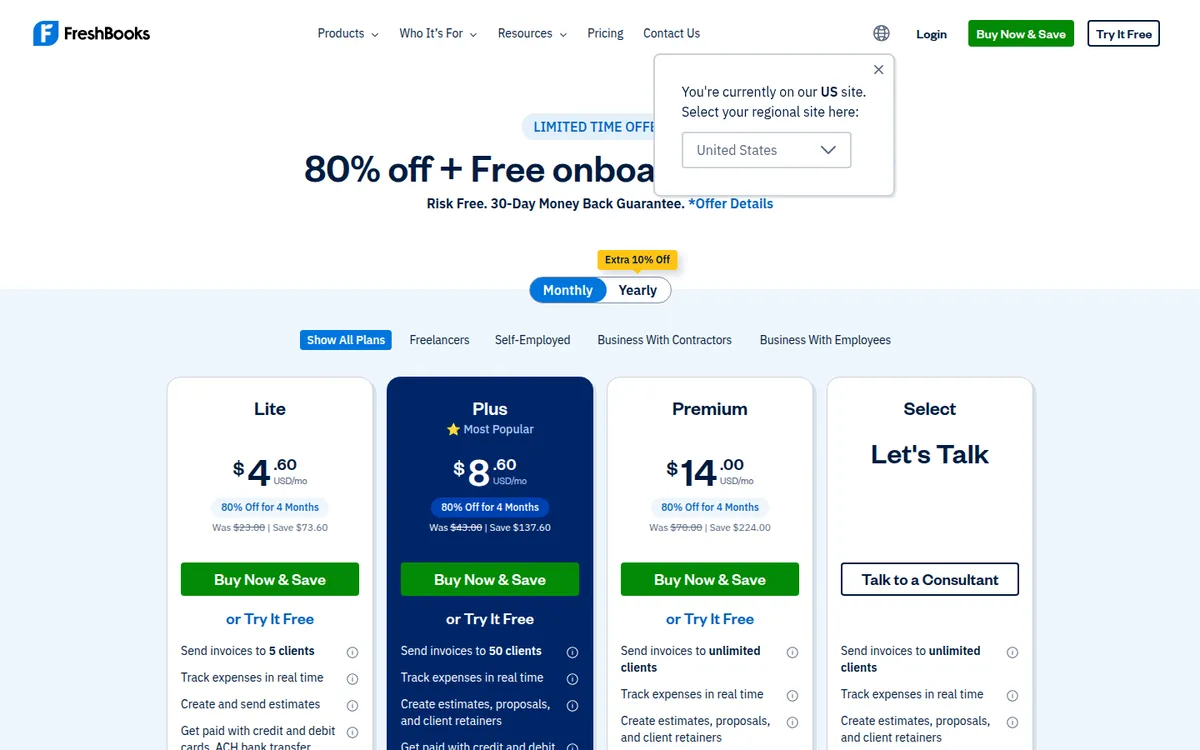
FreshBooks raised its base prices starting March 5, 2026, according to its price-change FAQ. These are the current U.S. list prices:
| Plan | Monthly | Billed yearly | Billable clients | What it adds |
|---|---|---|---|---|
| Lite | $23 | $248.40 a year ($20.70/month) | 5 | Unlimited invoices and estimates, recurring invoices, late fees and reminders, unlimited time tracking and expenses, bank import, mileage, bill pay |
| Plus | $43 | $464.40 a year ($38.70/month) | 50 | Proposals, e-signatures, client retainers, double-entry reports, bank reconciliation, accountant access, receipt capture |
| Premium | $70 | $756 a year ($63/month) | Unlimited | Project profitability, accounts payable, custom email templates, bill capture |
| Select | Quote only | Quote only | Unlimited | 2 team members included, lower card fees, Advanced Payments, removes FreshBooks branding |
Add-ons on the pricing page: team members at $11 a month each, Advanced Payments (card-on-file and virtual terminal) at $20 a month, and FreshBooks Payroll at $40 a month plus $6 per person.
Two details to watch:
- The client limit counts archived clients. The FAQ says the limit "refers to the number of both active and archived clients in your account." To free a spot on Lite, you have to delete a client, not just archive one.
- Lite is not full accounting. Double-entry reports, bank reconciliation and accountant access only start on Plus. If someone else does your taxes, Plus is the realistic starting point.
The promo changes often. On the same day, the pricing page offered 80% off for 4 months, while a banner on FreshBooks' invoicing page advertised 60% off for 3 months. FreshBooks also offers a 30-day free trial with no credit card and a 30-day money-back guarantee on purchases.
What QuickBooks Online costs in 2026
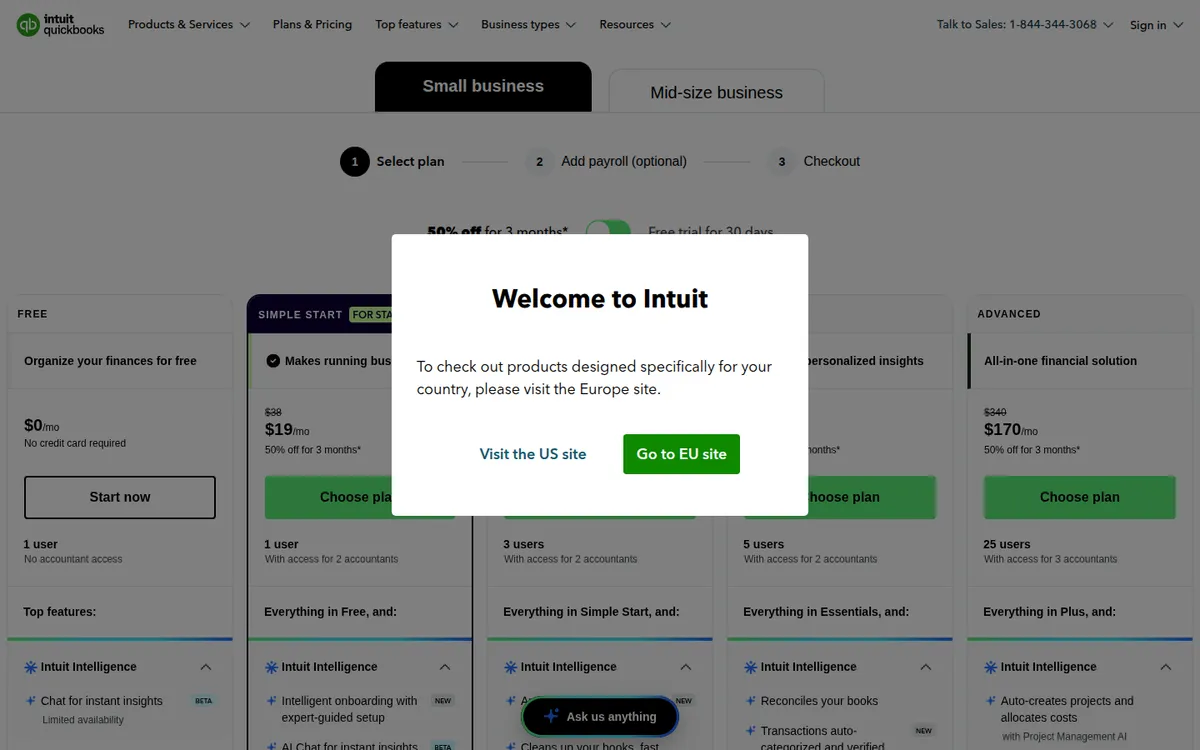
| Plan | List price | First 3 months (50% off) | Users | Accountants | What it adds |
|---|---|---|---|---|---|
| Free | $0 | — | 1 | None | Income and expenses, 2 invoices a month (unlimited with QuickBooks Payments), 3 reports, 1 bank connection |
| Simple Start | $38/month | $19 | 1 | 2 | Unlimited invoicing, bill pay with free ACH, expense categories, general reports |
| Essentials | $85/month | $42.50 | 3 | 2 | Enhanced reports, employee time on invoices, bulk invoices (beta) |
| Plus | $140/month | $70 | 5 | 2 | Inventory, project profitability, budgets, 40 classes and locations |
| Advanced | $340/month | $170 | 25 | 3 | Custom permissions, workflow automation, batch invoices, unlimited classes, priority support |
The page offers either 50% off for three months or a 30-day free trial. There's no annual contract. Intuit raised Essentials, Plus and Advanced for renewals from August 1, 2026, according to Insightful Accountant, so plan for more increases. We cover the full history in our QuickBooks Online review.
FreshBooks vs QuickBooks pricing: three real examples
The plan cards make both look cheap. Here's what you'd pay in year one (promo months included) and from year two, billed monthly. This is our own math from the two pricing pages on November 13, 2026, before taxes and payment fees.
| Scenario | FreshBooks | QuickBooks Online |
|---|---|---|
| Solo freelancer, 12 clients, wants an accountant to see the books | Plus: $378.40 year one, $516 a year after ($464.40 billed yearly) | Simple Start: $399 year one, $456 a year after |
| 3-person studio, everyone logs hours | Plus + 2 team members ($65/month): $642.40 year one*, $780 a year after | Essentials (3 users): $892.50 year one, $1,020 a year after |
| Online shop that tracks inventory | No inventory tools on any plan; you'd need a separate inventory app | Plus: $1,470 year one, $1,680 a year after |
*Assumes the 80% discount applies only to the base plan, not to team members. The pricing page doesn't say either way.
What this shows:
- Solo: the two are close. FreshBooks Plus is cheaper in year one because of the longer promo. QuickBooks Simple Start is about $60 cheaper every year after that. If you have 5 clients or fewer and don't need an accountant in the file, FreshBooks Lite at $23 is the cheapest real option on either side.
- Small team: FreshBooks wins clearly. Adding people at $11 each beats jumping from QuickBooks Simple Start (1 user) to Essentials (3 users).
- Products: QuickBooks is the only one of the two that does it.
Card and bank fees
Card fees are nearly a tie. FreshBooks charges 2.9% + $0.30 per standard card payment and 3.5% + $0.30 for American Express and business cards, per its price-change FAQ. QuickBooks charges 2.99% on invoiced cards, 2.5% in person and 3.5% for keyed cards. On a $1,000 invoice paid by a regular card, that's $29.30 on FreshBooks and $29.90 on QuickBooks. On a $100 invoice it's $3.20 versus $2.99. Both list ACH bank transfers at 1%. QuickBooks also says businesses processing over $2,500 a month may qualify for up to 25% off transaction costs.
Where FreshBooks is better
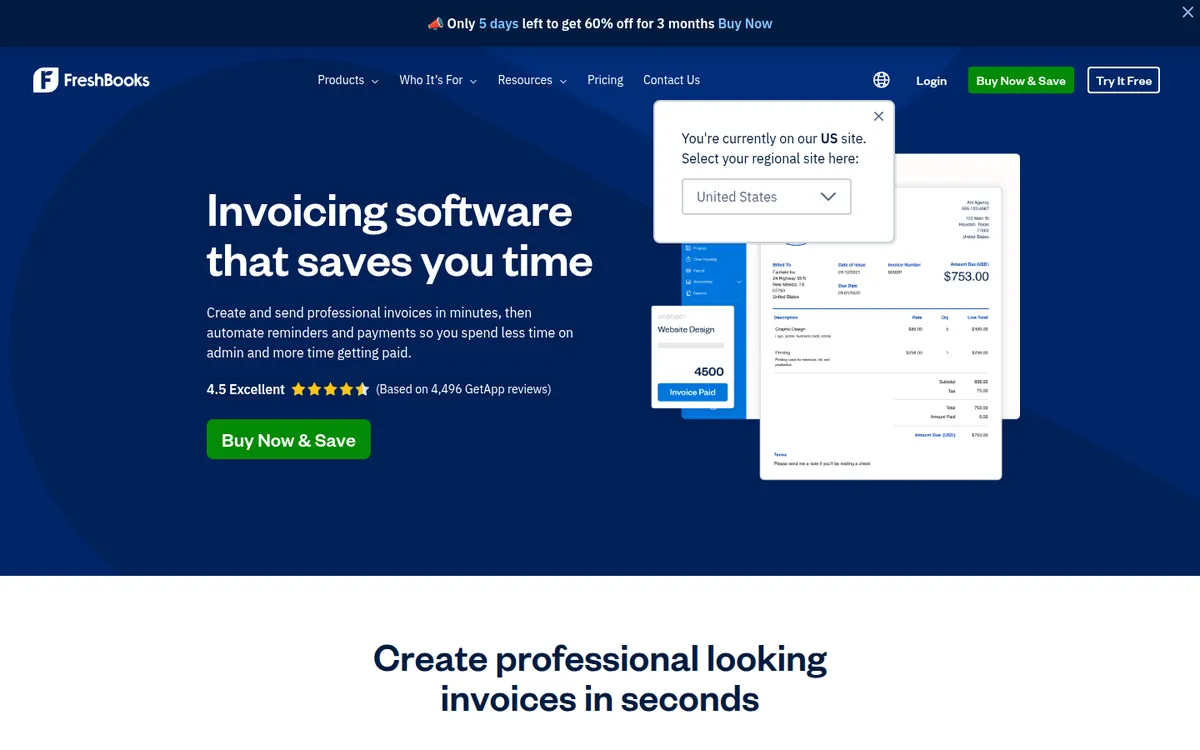
- Invoicing and getting paid. Every plan includes recurring invoices, scheduled late fees, automatic reminders, deposits and a client portal. Plus adds proposals with e-signatures and retainers. That's the daily work of a consultant or agency.
- Time tracking without a plan jump. Unlimited time tracking is on Lite. QuickBooks only lists adding employee time to invoices from Essentials ($85).
- Cheap extra people. $11 per team member, on any plan.
- Ease of use. In G2's FreshBooks vs QuickBooks Online comparison (as indexed in search; G2 blocks direct visits), FreshBooks scores 9.1 for ease of use against 8.2 for QuickBooks Online, and 4.5 stars against 4.0.
Where QuickBooks Online is better
- Accountants know it. Even Simple Start includes access for 2 accountants. NerdWallet notes that FreshBooks Lite doesn't allow accountant access, and a bookkeeper who already works in QuickBooks will usually charge less to clean up books they know.
- Products and inventory. Plus adds inventory tracking, plus classes and locations, project profitability and budgets. FreshBooks' plans don't list inventory at all.
- Room to grow. Advanced goes to 25 users with custom permissions and workflow automation. FreshBooks tops out at a quote-only Select plan.
- A free plan to start. QuickBooks Free is very limited (1 user, 2 invoices a month, 3 reports, no accountant), but it costs nothing. FreshBooks has a trial, not a free plan.
What users complain about
On Trustpilot, FreshBooks scores 3.8 from 1,059 reviews (59% five-star, 18% one-star). Recent complaints center on payments: unexpected charges, slow deposits, ACH fees and trouble updating billing details. One long-time customer wrote that prices keep rising without meaningful improvements. Praise focuses on friendly, quick phone support and simple invoicing.
QuickBooks scores 3.7 from 16,965 reviews on Trustpilot. Complaints are about reaching support (long waits and automated phone menus), a redesigned interface reviewers find confusing, features moved to higher plans, and difficulty canceling. Praise goes to patient onboarding staff and guided setup.
The pattern: FreshBooks complaints are mostly about money moving through FreshBooks Payments. QuickBooks complaints are mostly about support and the product getting more complex and more expensive.
Is FreshBooks or QuickBooks better for small business?
Choose FreshBooks if:
- You sell services: design, consulting, marketing, trades, coaching.
- You bill by the hour or by project and want time tracking from day one.
- You have 2 to 5 people and don't want to pay for a bigger plan just to add them.
- You have 50 clients or fewer (or are fine paying $70 for Premium).
Choose QuickBooks Online if:
- You sell physical products or need inventory.
- Your accountant or bookkeeper already uses QuickBooks.
- You want payroll, payments and accounting from one vendor and plan to grow past 5 users.
- You're solo and want the lowest long-run price with accountant access ($38 vs $43).
QuickBooks alternatives and FreshBooks alternatives
If neither fits, three options come up most often:
- Xero has unlimited users on every plan and is a common pick for growing teams. See QuickBooks vs Xero and our Xero review.
- Wave is free for core accounting and invoicing (you pay for payments and payroll). It's the usual "FreshBooks vs Wave" comparison for very small freelancers. We haven't reviewed it yet, so check its current terms.
- Zoho Books has a free plan for small revenue and paid plans starting around $15 a month, per our QuickBooks Online review.
FAQ
Is FreshBooks cheaper than QuickBooks?
At the entry level, yes: FreshBooks Lite is $23 a month and QuickBooks Simple Start is $38. But Lite allows only 5 clients and no accountant access. Comparing FreshBooks Plus ($43) with Simple Start ($38), QuickBooks is cheaper for a single user. With 2 or 3 people, FreshBooks is cheaper.
Can FreshBooks replace QuickBooks?
For a service business, often yes. FreshBooks Plus has double-entry reports, bank reconciliation and accountant access. For a product business, usually not, because FreshBooks doesn't list inventory tracking.
Do accountants prefer QuickBooks or FreshBooks?
QuickBooks is the more common choice among U.S. accountants and includes 2 accountant seats on every paid plan. FreshBooks supports accountant access from the Plus plan.
Does FreshBooks have a free plan?
No. It has a 30-day free trial with no credit card and a 30-day money-back guarantee. QuickBooks has a limited Free plan.
Can I switch from FreshBooks to QuickBooks later?
Yes. It's a common move once a business starts selling products or hiring. Neither pricing page explains migration in detail, so ask your accountant to move the opening balances, and switch at the start of a fiscal year so your reports stay clean.
The bottom line
FreshBooks is the better tool for people who bill clients. It's easier to learn, has time tracking on every plan, and adds staff for $11 each. QuickBooks Online is the better accounting system. It handles inventory, scales to 25 users and is what most accountants expect. Judge both on the full price, not the promo: $43 versus $38 a month for one person, $65 versus $85 for three.
Disclosure: if you buy through our links we may earn a commission. It never changes our verdict. Details.
Sources
- FreshBooks: Pricing (plans, client limits, team members, add-ons, payment fees, trial, money-back guarantee)
- FreshBooks: Price change 2026 FAQ (new U.S. monthly and yearly prices, card fee changes)
- FreshBooks: Invoicing software page
- QuickBooks: Plans and pricing
- QuickBooks Payments: Payment rates (as of September 18, 2026)
- QuickBooks Payroll: Pricing
- Insightful Accountant: the August 1st QuickBooks Online price changes
- G2: FreshBooks vs QuickBooks Online comparison
- NerdWallet: FreshBooks vs. QuickBooks Online
- TechRepublic: FreshBooks review
- FreshBooks reviews on Trustpilot
- QuickBooks reviews on Trustpilot
Prices and features checked on November 13, 2026. Vendors change plans often, so confirm on the official site before buying.