
Our verdict
The biggest open marketplace for small websites, stores, apps and domains, with low upfront listing fees and built-in escrow. Most listings are not manually vetted, so the buyer carries the due diligence.
- Best for
- Sellers of small online businesses and domains who want a large audience, and buyers who can do their own due diligence
- Skip if
- First-time buyers who expect the platform to vet listings for them, or sellers of larger profitable businesses who want a hands-on broker
- Price
- Listing from $29; 10% success fee on self-service sales (lower rates on some larger tiers); buying is free, Premium buyer plan $49/month
What works
- Very large marketplace covering websites, ecommerce stores, apps, SaaS and domains
- Low upfront cost: listings start at $29 for small assets
- Built-in escrow through FlippaPay or Escrow.com, plus identity checks
- Free for buyers to browse, message sellers and make offers
What doesn't
- Most small listings are not manually vetted, and edited screenshots and fake traffic are recurring complaints
- A 10% success fee on top of a non-refundable listing fee adds up on small deals
- Lots of low-quality or starter listings to sift through
- Some users report slow support and unqualified bidders
We have not bought or sold anything on Flippa. This guide is based on Flippa's own pricing page and help center, independent fee breakdowns and public user reviews. All sources are listed at the end. One disclosure: the Flippa links on this page are referral links, and we may earn a commission if you sign up through them. That does not change what we report below.
What Flippa is
Flippa is an online marketplace for buying and selling digital assets. Listings include content websites and blogs, ecommerce stores (Shopify, Amazon FBA and others), mobile apps, SaaS products, YouTube channels and domain names.
Its model is closer to eBay than to a traditional business broker. Sellers create a listing themselves, set an asking price or run an auction, and talk to buyers directly. Flippa supplies the audience, messaging, identity checks and a payment system with escrow. For larger deals it also offers a brokered service where a Flippa advisor runs the sale.
That open model is Flippa's biggest strength and its biggest risk. Anyone can list a $500 starter site next to a $2 million business, and on most small listings nobody at Flippa has checked the numbers.
How much Flippa costs
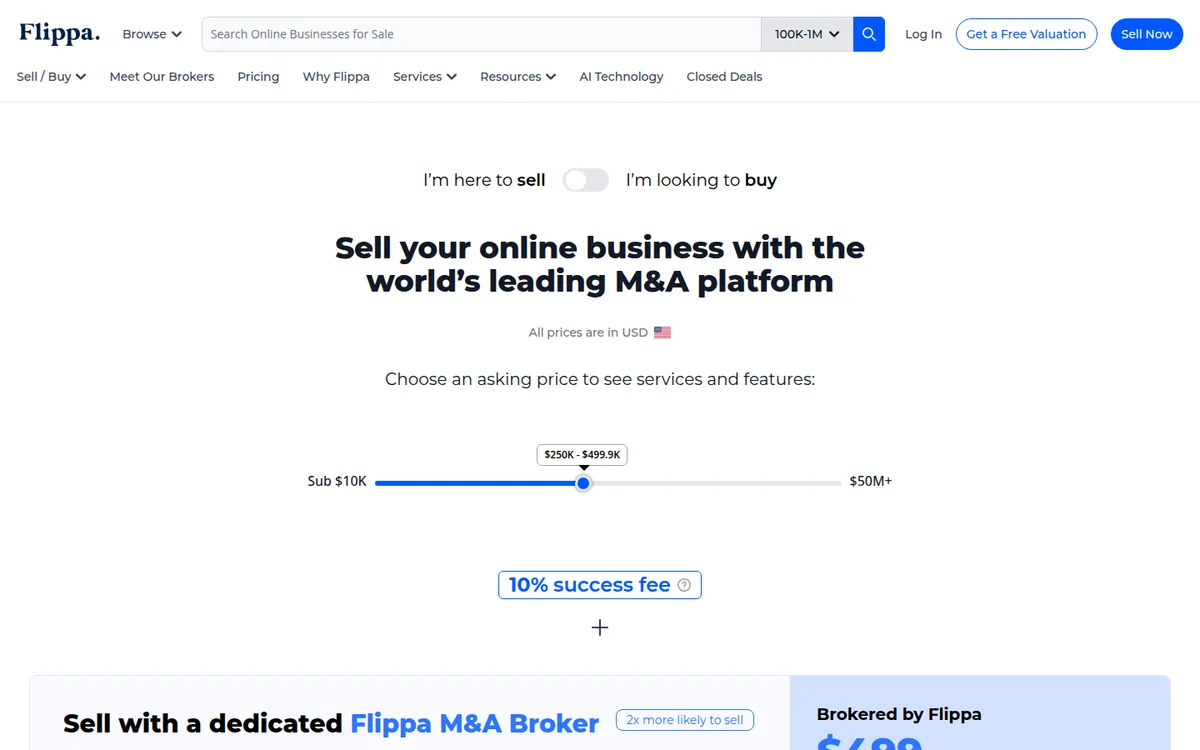
Flippa's pricing page lists the fees below on October 25, 2026. The page changes the packages you see based on your asking price, and the text we could read did not spell out every price band, so treat the mapping as a guide and confirm on Flippa's pricing page before you list.
Seller fees
| Package | Listing fee | Term | Success fee |
|---|---|---|---|
| Entry (small assets, under about $10K) | $29 | 60 days | 10% |
| Boosted reach | $49 | 3 months | 10% |
| Standard reach | $49 or $129 (by asking price) | 6 months | 10% |
| Premium | $199 to $399 | 6 months | 10% |
| Ultimate | $599 to $699 | 6 months | 10% |
| Brokered by Flippa | from $399 | 6 months | 10%, with a 9% tier shown for some larger deals |
A few details matter:
- The listing fee is paid upfront and is not refunded if your asset doesn't sell. The pricing page offers 50% off relists or the next renewal.
- The success fee is charged only when a sale closes. Flippa's page shows 10% for self-service listings, and our October 25 capture of the page shows 10% even for the $250K–$499.9K band. Independent guides disagree on whether and where the rate steps down for bigger sales (figures from 9% down to 3% at the very top end appear), so get the exact rate for your price band in writing before you sign.
- An NDA and confidential listing costs $199 on lower tiers and is included on Premium and Ultimate.
What this means in practice: on a $20,000 website sold with a $129 listing, the fees come to about $2,129 before payment fees, or roughly 10.6% of the price. On a $3,000 site with the $29 Entry package, you'd pay about $329.
Buyer fees
Browsing listings, messaging sellers and making offers is free. Flippa also sells a Premium buyer plan at $49 per month or $490 per year. According to the pricing page, Premium gives early access to listings during their first 21 days on the market.
Escrow and payment fees
Flippa's pricing page lists FlippaPay "from 1%" and Escrow.com "from 1.2%". The page does not say whether the buyer, the seller or both pay. That is usually agreed in the purchase agreement, so settle it before you accept an offer.
How escrow and verification work
This is the part to understand before any money moves.
FlippaPay. According to Flippa's help center, FlippaPay holds the buyer's money in a regulated trust account run by licensed payment partners. Both parties must pass Flippa's identity checks and sign an Asset Purchase Agreement first. The seller transfers the assets, and the buyer then clicks "Release Funds" and confirms by email. Flippa says it is used for deals over $10,000 or when its deal completion team offers it.
Escrow.com. The alternative uses a fixed inspection window after the assets arrive: 7 days for websites and online businesses, 3 days for apps and 2 days for domains, per Flippa's help center. If the buyer doesn't accept or raise a problem within that window, Escrow.com may release the funds automatically. Mark the date.
Identity checks. The pricing page lists identity verification with KYC/AML checks, plus phone and IP checks. That confirms who the seller is. It does not confirm that the revenue and traffic they claim are real.
Listing verification. Several independent reviews report that Flippa's human vetting focuses on higher-value listings (above $50,000 is the figure most often cited). Smaller listings typically rely on connected Google Analytics data and whatever the seller uploads. We could not find a current Flippa page that states the threshold, so treat it as reported, not confirmed.
Scams and risks users report
Escrow protects you from paying and receiving nothing. It doesn't protect you from overpaying for a business that was never what the listing said. The patterns that come up again and again in reviews and guides:
- Edited screenshots. Revenue and traffic screenshots can be altered in a browser before they are captured. Several sources call this the most common problem.
- Bought traffic. A seller can inflate visitor numbers with paid or bot traffic. A connected analytics account shows the traffic; it doesn't show that it's real or lasting.
- Padded or copied content. Some sites are stuffed with copied or mass-produced articles to look bigger than they are.
- Fake buyers and phishing. Some Trustpilot reviewers describe fake buyers and phishing attempts aimed at card or login details. Keep all talks and payments inside Flippa.
A fair caveat: some of the sharpest criticism comes from competing marketplaces, which have a reason to make Flippa look bad. The warnings still match what you'd expect from any open marketplace.
A due diligence checklist for buyers
- Ask for read access to Google Analytics and Search Console, not screenshots. A seller who refuses is a red flag.
- Check revenue at the source: Stripe, PayPal, Shopify, Amazon or affiliate dashboards, shown live on a video call.
- Look at the site's history on the Wayback Machine and its backlinks in an SEO tool.
- Confirm who owns the domain and how long it has been registered.
- Ask why they're selling and what work the site needs each week.
- Use FlippaPay or Escrow.com, never a direct transfer, and know your inspection window.
What users say
Flippa's Trustpilot page showed a 4.3 out of 5 score from about 3,300 reviews on October 25, 2026, with about two-thirds of ratings at 5 stars and 18% at 1 star. That split is typical of a marketplace where outcomes depend on who you deal with.
What reviewers praise: an easy-to-use site, smooth closings and payouts, and helpful, responsive advisors on brokered deals.
What reviewers complain about:
- Unqualified bidders who make offers they don't follow through on.
- Broker gaps, such as weeks without contact, and renewal fees charged while a listing sat unsold.
- Slow or unclear support around the deal completion process.
- Fees that some sellers felt weren't matched by the service.
Flippa replies to many reviews, though most of the replies we saw were short and templated.
Flippa vs the alternatives
| Flippa | Empire Flippers | Acquire.com | Motion Invest | |
|---|---|---|---|---|
| Model | Open marketplace + optional broker | Vetted broker | Marketplace focused on startups and SaaS | Marketplace + buys sites directly |
| Seller cost | Listing fee from $29 + 10% success fee | No listing fee; 15% on the first $700K, then lower bands; $10,000 minimum | Reported 4–8% depending on plan and price (sources disagree) | Reported 15–20% success fee; direct purchase has no fee |
| Buyer cost | Free; Premium $49/month | Free to browse; deposit to unlock listings | Free basic; paid membership from $390 | Free to browse |
| Vetting | Mostly on larger listings | Every listing vetted | Seller verification; buyer does diligence | Sites reviewed before listing |
| Best for | Small sites, stores, apps and domains | Established businesses with steady profit | SaaS and startups | Small content and affiliate sites |
Fees for Empire Flippers come from its selling FAQ and changelog (the minimum fee rose from $7,000 to $10,000 in February 2026). Acquire.com's buyer prices come from its pricing page; its seller fees and Motion Invest's fees come from independent sources, so confirm them on each site.
Choose Flippa if you're selling a small site, store, app or domain, want the widest audience and are comfortable handling buyer questions yourself.
Choose Empire Flippers if you have an established business with steady profit and would rather pay a higher commission for vetting and a broker who runs the sale. Its $10,000 minimum fee rules it out for small sites.
Choose Acquire.com if you're buying or selling a SaaS product or startup and want buyers who are used to those deals.
Choose Motion Invest if you have a small content or affiliate site and want a quick cash offer, accepting a lower price for speed.
Who Flippa fits
- Sellers of small online assets (roughly under $50K) who want the largest pool of buyers for a low upfront fee.
- Domain and app sellers who need a marketplace that takes those asset types.
- Experienced buyers who know how to verify traffic and revenue, and like hunting for underpriced deals.
Who should look elsewhere
- First-time buyers who expect the platform to vet listings. On Flippa, assume you're doing all of it.
- Sellers of larger profitable businesses who want a broker to qualify buyers and run the deal. A vetted broker may net you more despite the higher fee.
- Anyone selling a tiny site for a few hundred dollars, where the listing fee plus 10% eats a big share of the price.
Bottom line
Flippa is the default place to sell a small website, store, app or domain, and its fees are low upfront. Its open model means quality varies a lot, and the protection mostly covers the payment, not the claims in the listing. If you're selling, price in the listing fee plus 10%. If you're buying, verify everything at the source and close through escrow. If that sounds right, you can browse current listings or start a listing on Flippa.
Disclosure: if you buy through our links we may earn a commission. It never changes our verdict. Details.
Sources
- Flippa pricing page
- Flippa Help Center: How FlippaPay works
- Flippa Help Center: Using Escrow.com for Flippa transactions
- Flippa Help Center: Who authorizes the release of funds?
- Flippa reviews on Trustpilot
- Hackceleration: How much does Flippa cost?
- Investors Club: Common Flippa scams
- Making Sense of Cents: Flippa review
- Empire Flippers: Selling FAQ
- Empire Flippers changelog
- Acquire.com pricing
- Niche Pursuits: Motion Invest marketplace update
Prices and features checked on October 25, 2026. Vendors change plans often, so confirm on the official site before buying.